When a Wash Isn't Enough
You had the windows cleaned. They still look cloudy at the bottom third. That's not a bad cleaning job — it's mineral bonding, and hard water stain removal on windows in Tampa is a restoration process, not a washing one. Once calcium and silica from irrigation water have cured onto glass, soap and a squeegee will not touch them. They need to be dissolved or mechanically polished off.
The distinction matters because homeowners often blame the window cleaner, change companies, and get the identical result. The glass isn't dirty. It's damaged.
How do I tell hard water staining from dirt?
Three quick tests you can do yourself in about a minute:
- The wet test. Spray the glass with water. Dirt and film vanish while wet. Hard water staining stays visible, often as a cloudy band or a spray-pattern arc.
- The fingernail test. Light mineral deposit feels slightly rough. If the glass feels perfectly smooth but looks hazy, the minerals have etched into the surface — that's advanced.
- The location test. Look at where the haze is. Hard water staining follows the sprinkler: the lower third of first-floor windows, in arcs, heaviest on the side with the most heads. Dirt is uniform.
If the pattern is an arc that matches a spray head thirty feet away, you've diagnosed it.
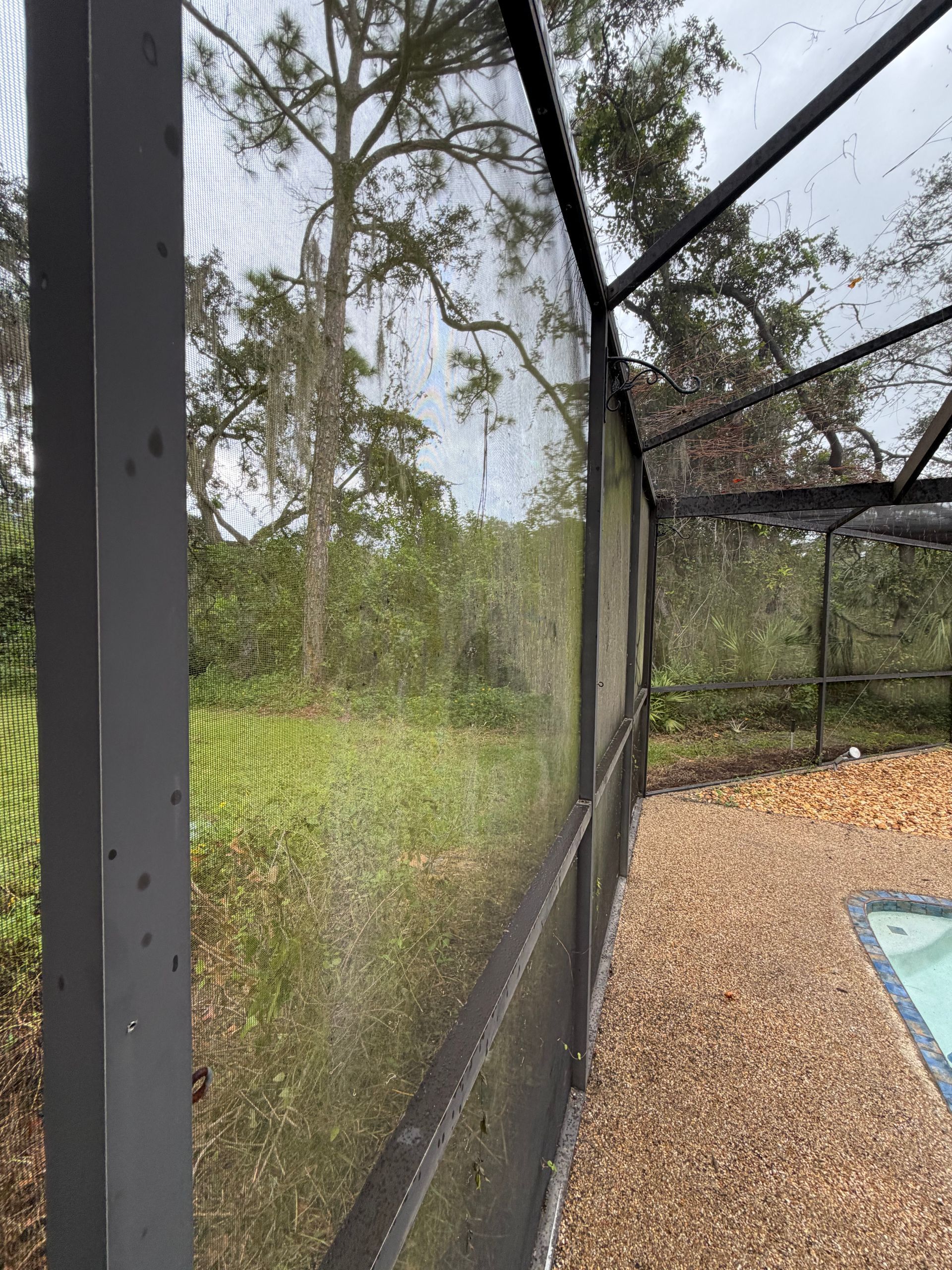
[PHOTO: close-up of sprinkler-arc hard water staining on the lower third of a window]
What actually causes it?
Tampa Bay water — municipal or well — carries dissolved calcium, magnesium, and silica. When a sprinkler hits glass and the Florida sun flashes that water off, the water leaves and the minerals don't. They dry, bond, and get a fresh coat every irrigation cycle.
Three to five years of this and the deposit stops being a film and starts being part of the glass surface. Silica in particular reacts with the glass itself. At that point you're no longer removing a layer, you're polishing out an etched one.
Salt air makes it worse near the water. On Culbreath Isles, Beach Park, and Sunset Park we see salt spray combine with irrigation minerals, which bonds faster and also attacks the aluminum frames and the screen spline at the same time.
Can etched glass be fixed, or does it need replacing?
It can usually be restored, and replacing impact windows over cosmetic staining is an expensive last resort. The ladder of options:
- Stage 1 — light deposit (under ~2 years): an acidic mineral cleaner, dwell, agitate, neutralize, rinse. Glass comes back fully clear.
- Stage 2 — moderate bonding (2–5 years): cleaner plus mechanical agitation with non-scratch pads, often two passes. Near-full clarity.
- Stage 3 — etched silica (5+ years): cerium oxide polishing compound with a variable-speed polisher, pane by pane. Slow, skilled work. Restores clarity but not instantly and not cheaply.
- Stage 4 — deep pitting: replacement. Rare, but it happens on homes where nobody adjusted a head for fifteen years.
What we won't do: take a razor or an abrasive pad to tempered or low-E coated glass as a shortcut. Tempered glass scratches with fabrication debris on the surface, and low-E coatings on the exterior lite can be destroyed in one pass. The test patch exists for a reason, and we always do one on an inconspicuous pane first.
How do I stop it from coming back?
This is the part that saves real money, and it's mostly free:
- Re-aim every head that hits glass, a wall, or a paver surface. Thirty minutes with a screwdriver.
- Water before dawn, not mid-morning — water that doesn't flash-dry in the sun leaves far less deposit.
- Install deflectors on heads that can't be re-aimed around tight beds.
- Rinse glass after window-washing season storms if you're on well water with high iron.
- Put exterior glass on a 6–12 month cleaning cycle so deposits never get the years they need to bond.
- Consider a hydrophobic glass sealant after restoration — it buys you a couple of years of easier maintenance.
Honestly, the sprinkler adjustment is 80% of the fix. We've restored glass on homes where the same two windows came back stained in eighteen months because nobody touched the irrigation, and homes where the restoration still looks perfect four years later because somebody spent half an hour with a screwdriver.
[PHOTO: before/after of a restored window pane, half polished half stained]
Get your glass evaluated
We'll tell you which stage your glass is at, do a free test patch, and give you a straight answer about whether it's a cleaning, a restoration, or a replacement conversation — our veteran-owned crew would rather lose a job than sell you a polish that won't work. Call 813-957-1174 for a free quote. More in our exterior cleaning overview, our residential services in Tampa, and what we cover for luxury pressure washing in Culbreath Isles.