Why Your Array Is Quietly Losing Output

Solar panel cleaning in Tampa matters more than most installers mention, because a dirty array in Florida loses real production — typically 5% to 15%, and higher on a low-slope roof that never sheds anything. Panels are glass, and glass in this climate collects pollen, salt film, pollution haze, bird droppings and the same algae spores that streak the tile around them. Washing them with soft-wash methods and pure water restores output without voiding anything.
The frustrating part is that you can't see it happening. A panel at 88% looks exactly like a panel at 100% from the driveway. You find out from the monitoring app six months later, and by then you've paid for the loss.
What actually dirties panels in Florida
It isn't dust. Four things do most of the damage here:
- Oak and pine pollen, February through April, which bonds to glass once it gets damp and then bakes on.
- Salt aerosol, which reaches a surprising distance inland off the bay and leaves a haze film that attracts everything else.
- Algae and lichen creep, migrating from the surrounding tile or shingle onto panel frames and the lower edge of the glass.
- Bird droppings, which are the worst offender by far. One well-placed dropping can shade a cell and knock an entire string's output down, not just that panel's.
Flat and low-slope arrays — common on the modern builds going up in Starkey Ranch, Long Lake Ranch and Bexley — are the ones that suffer most. A steep roof gets some self-cleaning from hard rain. A 10-degree array just holds the grime and lets the water evaporate around it.
[PHOTO: close-up of a panel half cleaned — visible haze line between washed and unwashed glass]
How often should solar panels be cleaned in Tampa Bay?
Once a year for most homes, twice a year if your array sits under or near oaks, faces heavy road traffic, or is within a mile or so of open water. The practical schedule we see work best:
- Late April or May — after pollen season has finished dropping, before peak summer production months you actually want to capture.
- October or November (optional second visit) — clears summer storm residue and leaf litter before the lower-angle winter sun, when every bit of output counts.
If your monitoring shows a gradual decline that doesn't track with weather or shading, that's your answer. Production data is the only honest report card a panel gives you.
Why pressure is the wrong tool for glass
This is where a lot of well-meaning homeowners get into trouble, and it's genuinely not obvious. Panels look tough. They survive hail and hurricanes. But the vulnerable parts aren't the glass — they're the perimeter seals, the junction boxes underneath, and the anti-reflective coating on the surface.
High pressure can drive water past a seal, micro-fracture a cell you'll never see, or scour the AR coating off and permanently dull the glass. Most manufacturers also void their warranty on pressure-washed panels. Abrasive pads and household glass cleaners cause their own problems: scratches, and surfactant residue that leaves a film attracting more dirt within a week.
What works is unglamorous:
- Soft brushes and a pure-water (deionized) rinse, so nothing dries into spots
- A mild, panel-safe detergent only where organic buildup demands it
- Work done from the ground with water-fed poles where reach allows, rather than walking an array
- Early morning or evening, never on hot glass — cold water on a 150-degree panel is how you crack one
The roof under the panels matters too
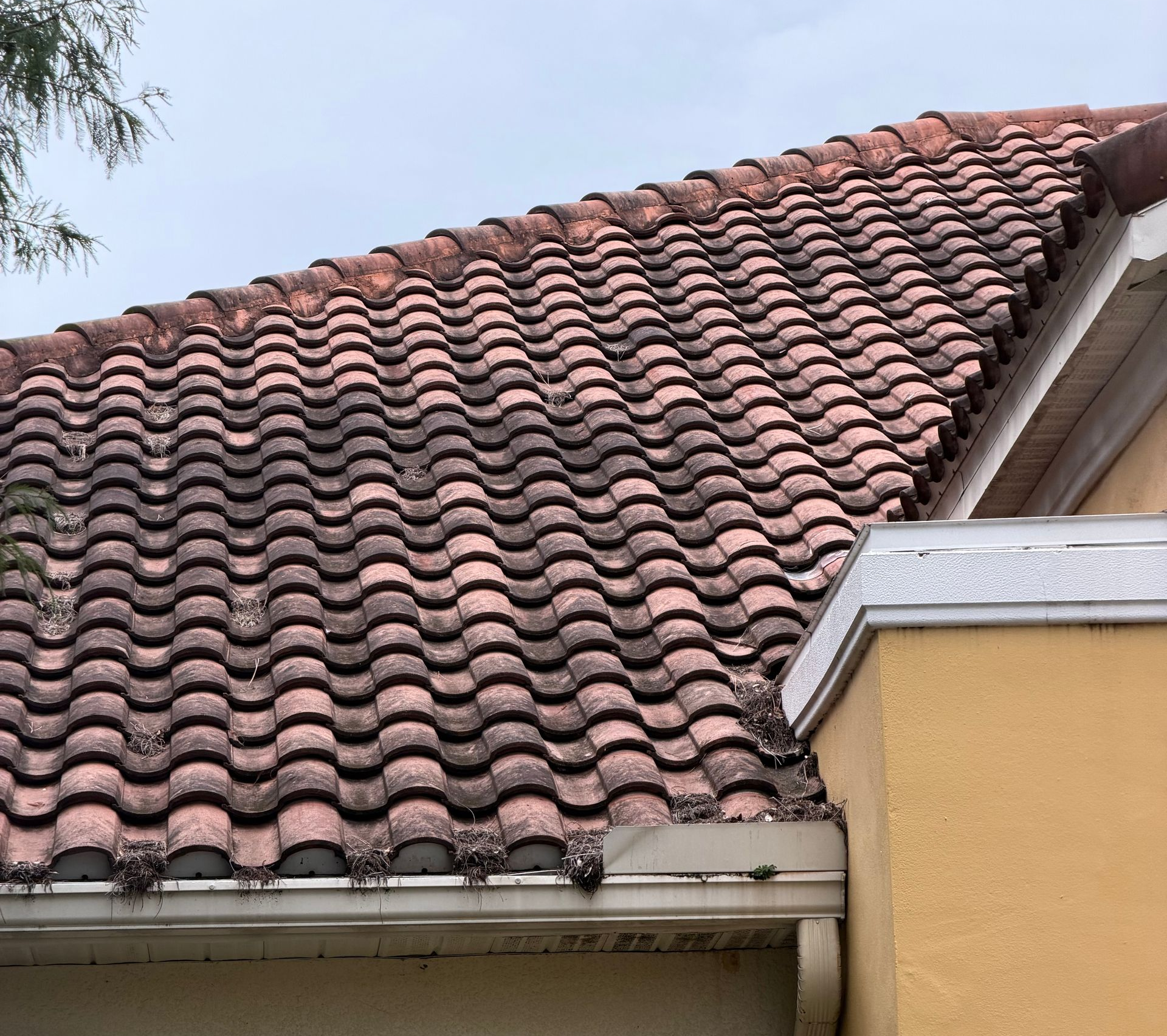
Here's the thing installers rarely say out loud: panels don't stop algae. They shade the roof, which is a damp, dark, perfect environment for it. We regularly find heavy black streaking on tile and shingle beneath and around arrays on homes whose owners thought the panels were protecting the roof.
That growth spreads back onto the panel frames, holds moisture against the roof deck, and on shingle roofs eats into the granules. Cleaning the array and skipping the roof is half a job. When we're already on a property for roof cleaning in Tampa, handling the panels in the same visit costs less and makes the whole plane look like it belongs together.
[PHOTO: wide shot of a tile roof with solar, heavy black streaking visible on the tile around the array]
What our visit looks like
- Inspect frames, seals and visible wiring, and photograph anything that looks like it needs your installer rather than us
- Protect landscaping and any ground-level inverter or disconnect
- Soft-brush and pure-water rinse, panel by panel
- Clear debris trapped under the array's lower edge and in the rails — a surprising amount of leaf litter lives there
- Recheck the glass dry, in daylight, for streaking before we pack up
We'll also tell you plainly if your panels don't need it yet. A clean array stays clean for a while, and selling you a wash you don't need is a bad way to keep a customer.
Get a quote
If your production numbers have drifted and you want to know whether it's dirt or something electrical, we'll take a look and tell you which. Call 813-957-1174 for a free quote on solar panel cleaning, or bundle it with exterior cleaning across the rest of the property. We're a veteran-owned Tampa company, and we work Hillsborough, Pasco and Pinellas — including the newer solar-heavy neighborhoods out in Starkey Ranch.