Stucco cleaning Tampa
Stucco cleaning in Tampa runs into one problem constantly: homeowners treating white chalky bloom as if it were mold. It isn't. That powdery white haze is efflorescence — mineral salt pushed out of the wall from the inside by moisture — and the soft-wash chemistry that erases black mold does almost nothing to it. Two different stains, two different fixes.
So before anybody sprays anything, it's worth knowing which one you've got. The test takes ten seconds.
Efflorescence vs. mold: how to tell them apart
Efflorescence is white to off-white, powdery or crystalline, and it wipes off dry on your fingertip like chalk dust. It appears in blotches and drip patterns, usually on the lower third of a wall, around window and door headers, near the slab, and under any spot where water sits or sheds. It feels gritty. It comes back.
Mold, mildew and algae are gray, green or black, feel slimy rather than gritty when damp, and will not wipe off dry. They favor north and east walls, shaded elevations, and anywhere the irrigation hits.
Quick field test: dab a drop of water on the white patch. Efflorescence dissolves and darkens the wall temporarily. Mold just gets wet.
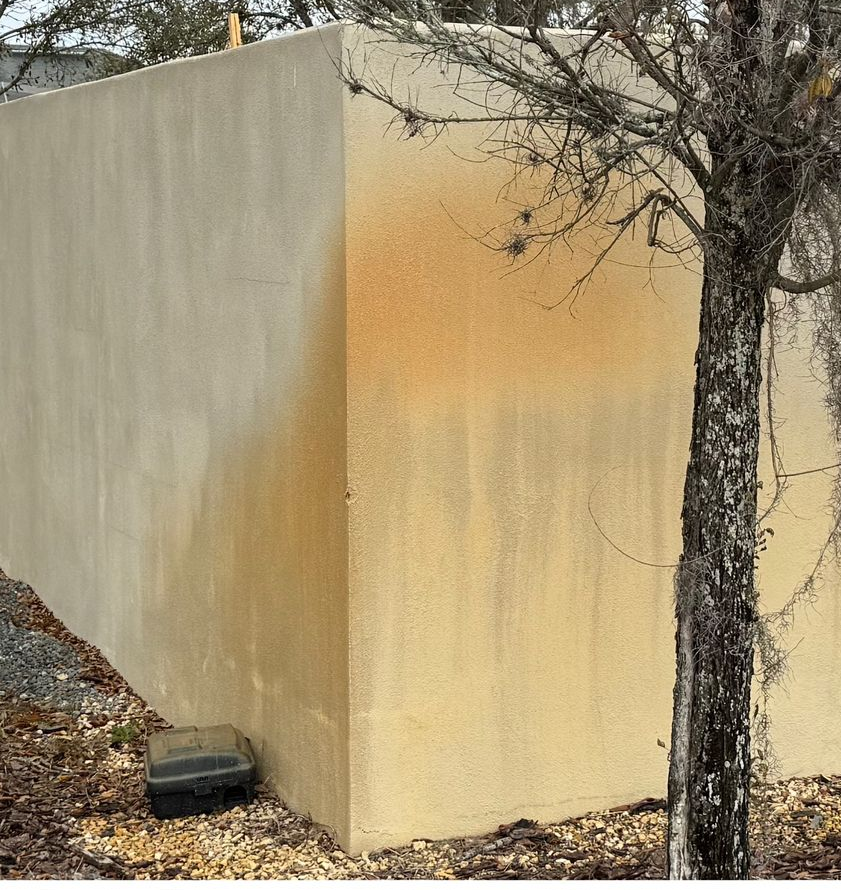
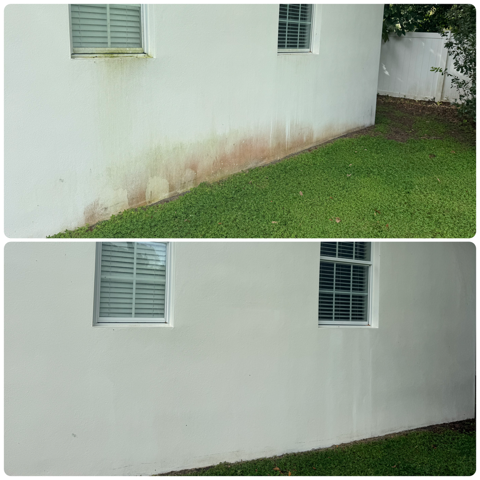
[PHOTO: close-up of stucco wall showing both — white efflorescence bloom low on the wall, dark algae streaking above]
Why new construction gets it worst
If you've bought in Wesley Chapel, Long Lake Ranch, Bexley or anywhere the trucks are still rolling, you may be seeing this on a two-year-old house and wondering what went wrong. Usually nothing did.
Fresh cement products carry a lot of free lime and soluble salt. For the first couple of years, every rain cycle drives moisture into the wall and the drying pulls dissolved salt back to the surface, where the water evaporates and leaves the mineral behind. Builders call it new-construction bloom. It genuinely does diminish over time.
What makes it stop being normal and start being a problem:
- Bloom that keeps appearing in the same spot years later — that's an ongoing water source, not curing
- Heavy bloom directly under a window — often a flashing or caulk-joint failure
- Bloom at the base of a wall where a sprinkler head hits — easiest fix on this list, just redirect the head
- Bloom with soft or crumbling stucco behind it — that needs a stucco contractor before it needs us
Why scrubbing it makes it worse
Here's the counterintuitive part, and it's the mistake we're called in to undo most often. Attacking efflorescence with a pressure washer and a lot of water does three bad things: it drives more water into the wall, which feeds the next bloom; it can abrade the stucco's finish texture, leaving a permanently lighter smooth patch; and because the salt is water-soluble, the wall looks cured the moment it's wet and the bloom returns as it dries.
People wash it, it disappears, they're thrilled, and a week later it's back worse. That cycle isn't anyone's bad luck — it's the chemistry doing what it was always going to do.
What actually removes each one
For efflorescence:
- Dry-brush the loose crystalline material off first, with as little water as possible
- Apply a dilute, stucco-rated acidic cleaner that converts the salt rather than just wetting it
- Neutralize and rinse thoroughly at low pressure
- Identify and stop the water source — otherwise you're booking us again next spring
- Where appropriate, a breathable masonry sealer, applied only after the wall has fully dried out
For mold and algae: low-pressure soft washing with a properly mixed cleaning solution, dwell time, and a gentle rinse. The chemistry kills the organism at the root so it doesn't regrow in six weeks. No pressure is needed, and pressure is what cracks, stripes and water-logs stucco walls.
On a typical Tampa Bay house we find both at once, which means two processes on two parts of the same wall in the same visit. That's normal, and it's a big part of why house washing on stucco is a different job than washing vinyl or hardie board.
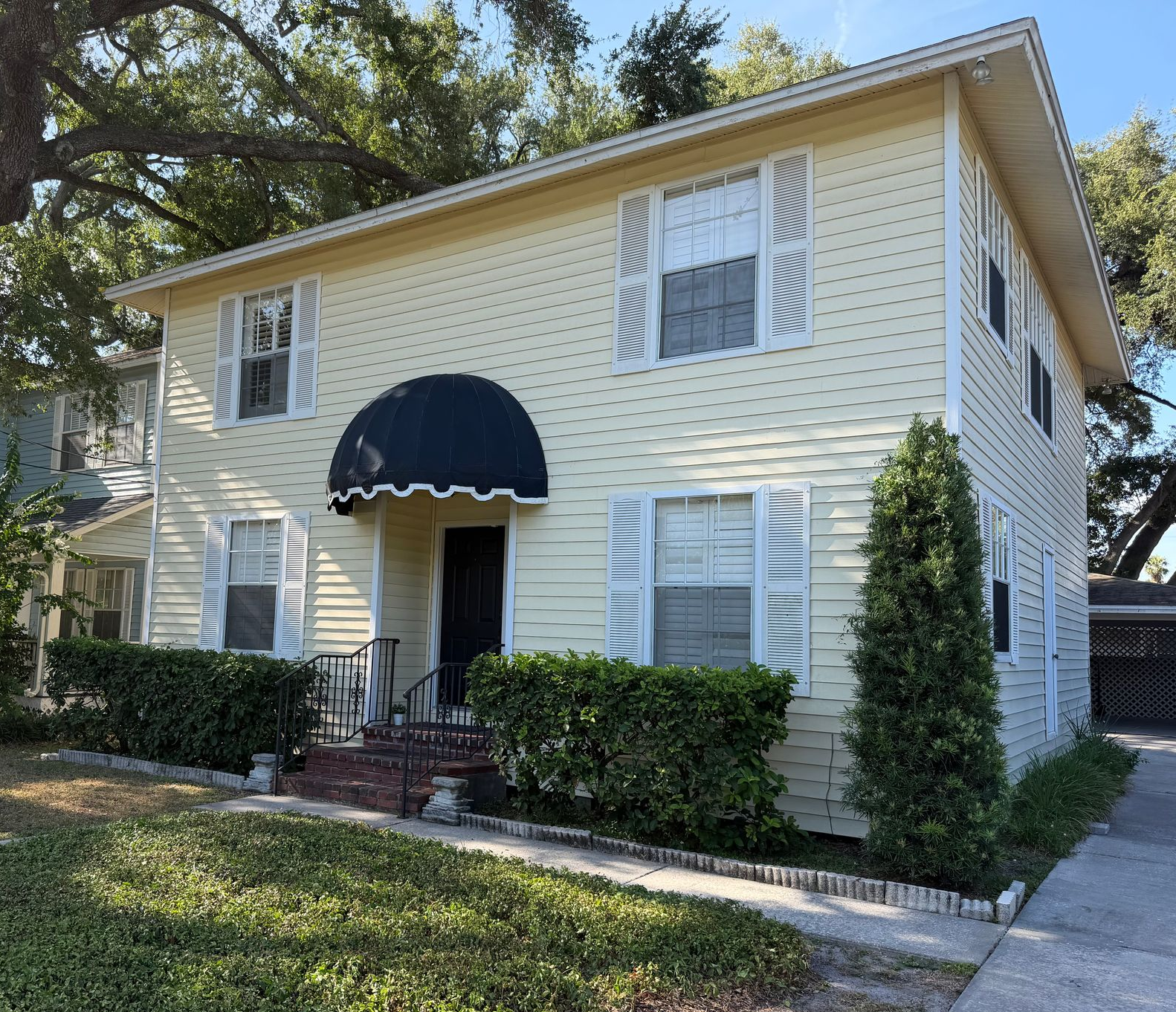
[PHOTO: full elevation after soft washing — uniform stucco color, no white bloom at the slab line]
A realistic expectation
We'll tell you straight: efflorescence can take two treatments, and if the moisture source is still active it will return. That's not a failed wash, it's a wall that's still wet somewhere. Any company promising a permanent one-visit cure for salt bloom without discussing where the water is coming from is selling you the first half of a two-part problem.
What we can promise is that we'll identify which stain is which, treat each correctly, leave the finish texture intact, and tell you what's causing it — even when the answer is "call your builder while the warranty's live."
Get a quote
Not sure whether you're looking at mold, efflorescence, or both? Send a photo or call 813-957-1174 and we'll tell you what it is before we quote it, rather than after.
Wild West Washing is veteran-owned and works Hillsborough, Pasco and Pinellas, including the newer stucco neighborhoods across Wesley Chapel.